Sequential Domain Reduction
Background
Sequential domain reduction is a process where the bounds of the optimization problem are mutated (typically contracted) to reduce the time required to converge to an optimal value. The advantage of this method is typically seen when a cost function is particularly expensive to calculate, or if the optimization routine oscilates heavily.
Basics
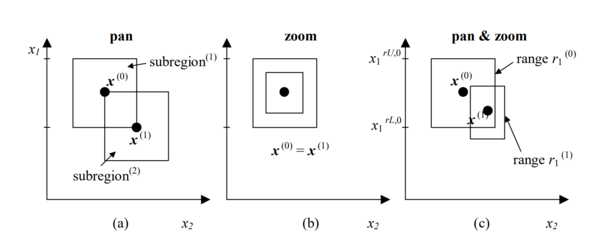
The basic steps are a pan and a zoom. These two steps are applied at one time, therefore updating the problem search space evey iteration.
Pan: recentering the region of interest around the most optimal point found.
Zoom: contract the region of interest.
Parameters
There are three parameters for the built-in SequentialDomainReductionTransformer object:
\(\gamma_{osc}:\) shrinkage parameter for oscillation. Typically [0.5-0.7]. Default = 0.7
\(\gamma_{pan}:\) panning parameter. Typically 1.0. Default = 1.0
\(\eta:\) zoom parameter. Default = 0.9
More information can be found in this reference document:
Title: “On the robustness of a simple domain reduction scheme for simulation‐based optimization”
Date: 2002
Author: Stander, N. and Craig, K.
Let’s start by importing the packages we’ll be needing
[1]:
import numpy as np
from hbayes import BayesianOptimization
from hbayes import SequentialDomainReductionTransformer
import matplotlib.pyplot as plt
Now let’s create an example cost function. This is the Ackley function, which is quite non-linear.
[2]:
def ackley(**kwargs):
    x = np.fromiter(kwargs.values(), dtype=float)
    arg1 = -0.2 * np.sqrt(0.5 * (x[0] ** 2 + x[1] ** 2))
    arg2 = 0.5 * (np.cos(2. * np.pi * x[0]) + np.cos(2. * np.pi * x[1]))
    return -1.0 * (-20. * np.exp(arg1) - np.exp(arg2) + 20. + np.e)
We will use the standard bounds for this problem.
[3]:
pbounds = {'x': (-5, 5), 'y': (-5, 5)}
This is where we define our bound_transformer , the Sequential Domain Reduction Transformer
[4]:
bounds_transformer = SequentialDomainReductionTransformer()
Now we can set up two idential optimization problems, except one has the bound_transformer variable set.
[5]:
mutating_optimizer = BayesianOptimization(
    f=ackley,
    pbounds=pbounds,
    verbose=0,
    random_state=1,
    bounds_transformer=bounds_transformer
)
[6]:
mutating_optimizer.maximize(
    init_points=2,
    n_iter=50,
)
[7]:
standard_optimizer = BayesianOptimization(
    f=ackley,
    pbounds=pbounds,
    verbose=0,
    random_state=1,
)
[8]:
standard_optimizer.maximize(
    init_points=2,
    n_iter=50,
)
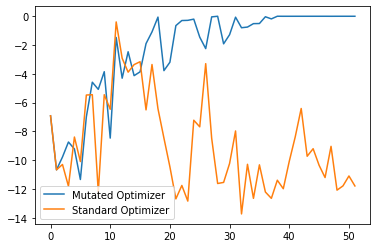
After both have completed we can plot to see how the objectives performed. It’s quite obvious to see that the Sequential Domain Reduction technique contracted onto the optimal point relativly quickly.
[9]:
plt.plot(mutating_optimizer.space.target, label='Mutated Optimizer')
plt.plot(standard_optimizer.space.target, label='Standard Optimizer')
plt.legend()
[9]:
<matplotlib.legend.Legend at 0x7f2e01d452e8>
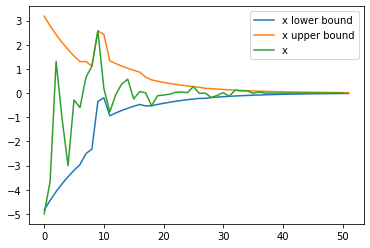
Now let’s plot the actual contraction of one of the variables (x)
[10]:
# example x-bound shrinking
x_min_bound = [b[0][0] for b in bounds_transformer.bounds]
x_max_bound = [b[0][1] for b in bounds_transformer.bounds]
x = [x[0] for x in mutating_optimizer.space.params]
[11]:
plt.plot(x_min_bound[1:], label='x lower bound')
plt.plot(x_max_bound[1:], label='x upper bound')
plt.plot(x[1:], label='x')
plt.legend()
[11]:
<matplotlib.legend.Legend at 0x7f2e01c47710>